
Citizen science and urban heritage: Participatory mapping on the impact of tourism around the Sagrada Família
Participatory mapping on the impact of tourism around the Sagrada Família
TURBA'S PRINCIPAL INVESTIGATOR/S
Summary
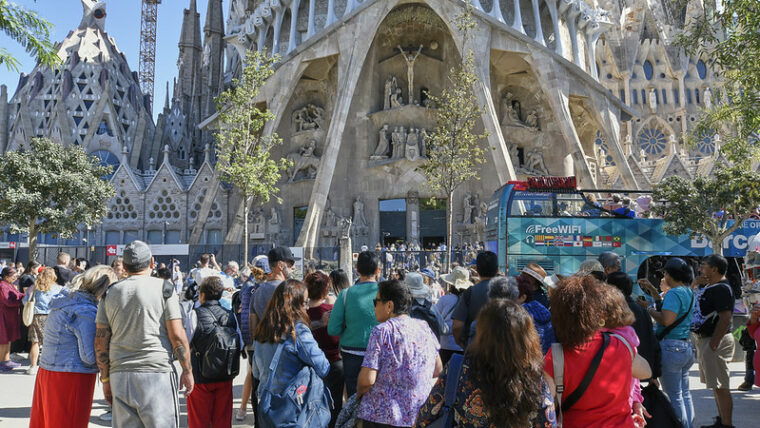
The project addresses one of the most complex issues in contemporary Barcelona: the tension between tourism pressure and the sustainability of everyday life within a context of accelerated urban transformation. Using the area surrounding the Sagrada Família –one of the city’s most tourist-intensive locations– as a case study, the project analyzes the impacts of this pressure on the neighborhood’s daily life and urban dynamics.
The proposal adopts a comprehensive approach that links urban change with the neighborhood’s preeminent symbolic element: the Sagrada Família temple. The initial premise holds that urban redevelopment acts as a profound intervention that calls the very meaning of heritage into question. By positioning residents as co-producers of knowledge, the project aims to evaluate in real time how alterations to the built environment reshape the concept of monumentality. Through direct engagement with local inhabitants and visitors, it will identify how the new urban design transforms collective imaginaries. The project seeks to transcend the static, “authorized” view of heritage –often restricted to architectural excellence– to understand it as a living, dynamic ecosystem. Through participatory workshops, mapping initiatives will be created to highlight the area’s intangible values and everyday memories, facilitating the transition from a contemplative heritage to a fully lived one.
The project’s methodology is grounded in participatory mapping, conceived as a citizen science tool to influence urban management. The process relies on gathering a diverse range of citizens using intersectional criteria (gender, age, background, and functional diversity) to ensure heritage is defined through plurality. This collective diagnosis is articulated through “Everyday Memory Workshops.” These participatory sessions invite participants to share personal photographs, domestic graphic material, and oral accounts of the neighborhood. The activity aims to map the sector’s symbolic and affective shifts to bring to light the lived experiences and community bonds that official narratives and commercialization processes often obscure. Ultimately, the objective is to subvert dominant narratives and reaffirm the right to the neighborhood, championing the richness of its popular memory and everyday history as a living heritage.
Systematizing these lived experiences into collaborative maps will make it possible to identify “invisible layers” of meaning that extend beyond the institutional understanding of urban heritage. In doing so, the project aims to serve as a knowledge transfer tool to inform public policy, ensuring that the management of urban space and heritage continuously reflects the social reality and ways of living in contemporary Barcelona.
Related projects
Harnessing Agricultural Renewal via Voice, Engagement, Storytelling and Transformation
Farming in Europe is essential but undervalued and misunderstood. Previous research has addressed innovation, resilience, and community engagement;…
Citizen science in motion. Navigation strategies of sighted and visually impaired people in traffic-calmed environments.
Citizen Science Step-by-Step: Navigation strategies and pedestrian trajectories in traffic-calmed areas (2nd Edition)
Walked Streets. Observatory of citizen science in motion
Walking the Territory: Reconnecting Human and More-than-Human Relations in the Besòs River Delta
Socio-ecological reshaping of European Cities and Metropolitan Areas
With our early-career network we address pressing societal challenges of living and ecology in urban agglomerations. Societies in…

WELLCOM. Commoning Wellbeing in Barcelona Urban Gardens: Characterization and Assessment
European Performing Science Program (EPSP)
AIGÜES: Arte, Inclusividad y Gobernanza del agUa: Escenarios Sensibles
A Rounder Sense of Purpose II – RSPII
GINA: Gender-Inclusive Adaptation. Understanding the effects of climate gentrification
Citizen science Step-by-step: pedestrian navigation strategies and everyday routes in traffic-calmed areas (1st Edition)